

Introduction
Language is more than a tool for sharing information. It is also a wonderful way to express creativity, humor, and imagination. Sometimes, a simple sentence can make someone laugh because a particular word carries two different meanings. This playful use of language is known as wordplay, and one of its most entertaining forms involves clever expressions that surprise readers or listeners. Understanding the real puns meaning helps people appreciate how ordinary words can create extraordinary moments of humor. Whether someone enjoys funny jokes, creative writing, social media captions, or everyday conversations, learning about wordplay can make communication more interesting and memorable.
Humor based on language has existed for centuries, appearing in literature, theater, poetry, advertisements, and casual discussions. Today, it remains equally popular in digital communication, where people frequently share humorous captions, memes, and short jokes. A clever phrase can attract attention because it combines familiar language with an unexpected interpretation. This combination encourages people to think differently about words they already know. Learning how these expressions work can improve vocabulary, strengthen creative thinking, and make everyday communication more enjoyable.
The interesting thing about word-based humor is that it does not always require complicated vocabulary or advanced language skills. Even beginners can recognize a clever joke when they understand the relationship between its different meanings. With simple explanations and relatable examples, anyone can discover how playful language creates laughter while improving their understanding of English.
What Is the Real Meaning of Puns?
Puns are a form of wordplay in which a speaker or writer uses words with multiple meanings or similar sounds to create humor, surprise, or a clever connection. The technique works by encouraging the audience to interpret a word or phrase in more than one way. Sometimes, the humor comes from a single word that has two meanings. In other situations, two different words sound alike but have completely different definitions. The unexpected connection between these interpretations creates the amusing effect.
For example, consider the sentence, “I used to be a baker, but I couldn’t make enough dough.” The word “dough” refers to the mixture used for making bread, but it can also informally mean money. The sentence becomes humorous because both meanings fit the situation. Another example is, “The bicycle couldn’t stand on its own because it was two-tired.” Here, “two-tired” sounds like “too tired,” creating a playful connection between a bicycle’s wheels and a person’s exhaustion. These examples demonstrate how a small change in interpretation can transform an ordinary statement into an entertaining joke.
Why Wordplay Is an Important Part of English
Wordplay plays an important role in English because the language contains many words with similar pronunciations, multiple definitions, and flexible meanings. These characteristics provide countless opportunities for humorous expressions. Writers and speakers often use them to make conversations more engaging or to communicate ideas in memorable ways. A clever sentence can capture attention faster than a straightforward explanation because it encourages the audience to discover a hidden meaning.
Beyond entertainment, wordplay supports language development. When learners encounter a joke involving two meanings, they must consider vocabulary, pronunciation, and context simultaneously. This process encourages deeper understanding and helps people remember unfamiliar expressions. It also demonstrates how language depends on context rather than isolated dictionary definitions. In classrooms, teachers may introduce humorous examples to make difficult vocabulary easier to understand. Similarly, creative professionals use wordplay to make messages distinctive and memorable.
Different Types of Wordplay and Their Meanings
Not every humorous expression works in the same way. Some depend on pronunciation, while others rely on spelling or multiple meanings. Understanding these differences makes it easier to recognize the structure behind a joke and appreciate why it works.
Homophonic Wordplay
Homophonic wordplay involves words that sound alike but have different meanings and often different spellings. The humor appears when one word is replaced by another with a similar pronunciation. For instance, “The fisherman was hooked on his new hobby” connects the fishing meaning of “hooked” with the expression describing strong interest. A clearer sound-based example is, “A horse is a very stable animal.” Here, “stable” can describe reliability or refer to the building where horses are kept.
Another familiar example is, “The math teacher had too many problems.” The word “problems” can describe mathematical exercises or personal difficulties. Although this example relies on multiple meanings rather than identical sounds, it illustrates how related techniques can overlap in everyday humor. Sound-based jokes are particularly effective in spoken conversations because listeners recognize the unexpected interpretation through pronunciation.
Homographic Wordplay
Homographic wordplay uses words that share the same spelling but have different meanings. In some cases, the pronunciation may also change depending on the intended definition. This creates opportunities for clever expressions that challenge readers to identify the correct interpretation.
Consider the sentence, “The musician was very sharp during the performance.” The word “sharp” may describe intelligence, musical pitch, or something with a pointed edge. Another example is, “The bank manager had a lot of interest in his work.” Here, “interest” can mean curiosity or money earned through financial arrangements. The humor depends on recognizing both interpretations within the same sentence. These expressions show how familiar vocabulary can become entertaining when placed in an unexpected context.
Compound Wordplay
Compound wordplay combines two or more humorous interpretations within a single expression. It may involve several words with double meanings or multiple sound-based connections. This type is often more challenging because the audience must recognize more than one linguistic relationship.
For example, a humorous description of a struggling musician might say, “He lost his rhythm and couldn’t find the right note to pay his bills.” The sentence connects musical notes with financial notes or written reminders, although the strength of the joke depends on the surrounding context. Compound expressions are common in comedy writing because they allow creators to build increasingly elaborate jokes. However, successful examples still need to sound natural rather than unnecessarily complicated.
Visual Wordplay
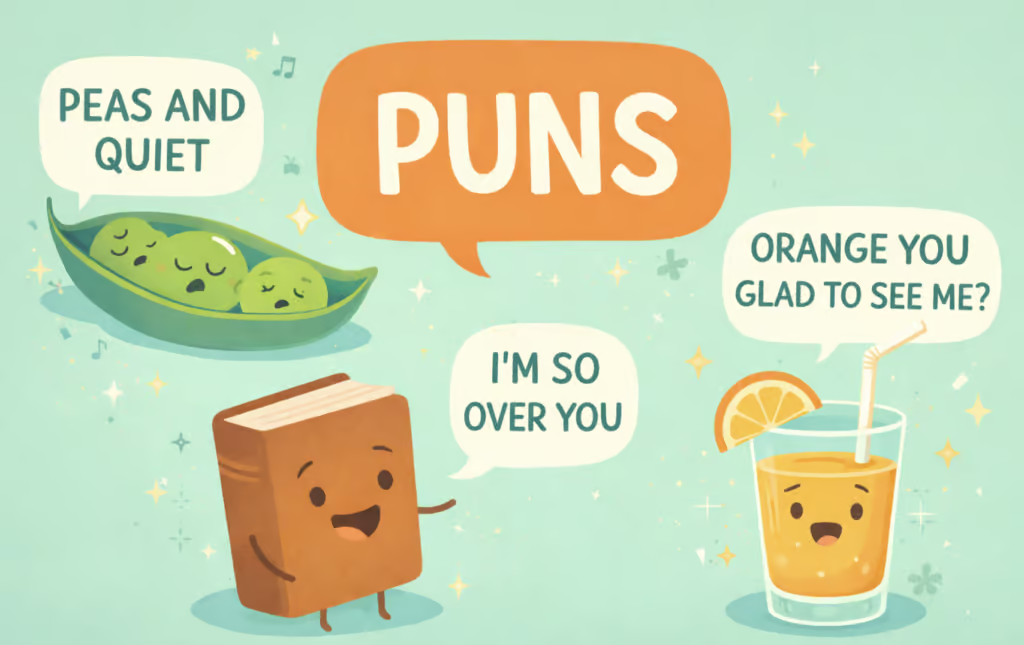
Visual wordplay depends on how words, images, or symbols appear rather than only how they sound. It is frequently used in advertising, cartoons, greeting cards, and digital illustrations. A drawing of a smiling sun accompanied by the phrase “You brighten my day” combines an image with a familiar expression to strengthen its playful meaning.
In modern digital communication, visual humor is particularly effective because audiences often understand the message immediately. Designers may combine illustrations with short phrases to create memorable content. Although visual wordplay differs from traditional verbal jokes, it follows the same basic principle of connecting two interpretations in an unexpected way.
Simple and Funny Examples for Everyday Understanding
The easiest way to understand Puns is through relatable situations involving food, animals, school, work, and daily activities. These subjects are familiar to most people, making it easier to recognize the hidden meanings behind humorous expressions. For example, “I’m reading a book about anti-gravity. It’s impossible to put down” creates humor because “put down” can mean placing a book on a surface or stopping reading because it is interesting. The two interpretations connect naturally, making the sentence both understandable and entertaining.
Food-related expressions are especially popular because ingredients and cooking activities often have names that resemble other words. A common example is, “Lettuce celebrate!” The word “lettuce” sounds similar to “let us,” creating a playful invitation. Another example is, “You’re one in a melon,” which replaces “million” with the name of a fruit. These expressions are commonly used in greeting cards, friendly messages, and creative captions because they communicate positive feelings through humor.
Examples Across Different Categories
| Category | Creative Example | Explanation |
|---|---|---|
| Food | Lettuce celebrate! | “Lettuce” sounds like “let us.” |
| Animals | What a purr-fect day! | “Purr” replaces part of “perfect.” |
| Education | The math teacher has too many problems. | “Problems” refers to exercises and difficulties. |
| Books | The book about anti-gravity is impossible to put down. | “Put down” has literal and figurative meanings. |
| Music | The pianist found the key to success. | “Key” refers to a musical key and a solution. |
| Nature | The gardener’s business is growing. | “Growing” describes plants and business development. |
These examples show that clever wordplay can be created from ordinary experiences. The strongest expressions usually rely on familiar vocabulary and situations where both interpretations make sense. When the connection is clear, readers experience a brief moment of surprise followed by understanding. This makes the joke memorable without requiring a lengthy explanation.
How Wordplay Creates Humor in the Human Mind
Humor often appears when expectations are interrupted. During normal communication, people automatically select the most likely meaning of a word based on its surrounding context. When a sentence unexpectedly introduces another interpretation, the brain must reconsider its original understanding. This sudden shift can create amusement, especially when the alternative meaning fits the situation in a surprising way.
Puns are effective because they encourage this mental shift without requiring an elaborate story. A short sentence can establish an expectation and then change it through a single word. For example, “The calendar’s days are numbered” initially sounds like a warning that something will soon end. However, calendars literally contain numbered days, making the expression amusing. The humor comes from recognizing the difference between the figurative expression and its literal interpretation. Personal experience, language proficiency, and cultural familiarity can influence whether someone finds a particular example funny.
The Role of Creative Language in Modern Communication
Digital communication has created new opportunities for humorous language. Social media platforms, messaging applications, online communities, and marketing campaigns frequently use short, memorable expressions to attract attention. A playful caption can make an ordinary photograph more interesting, while a clever slogan can help an advertisement stand out among competing messages.
Puns are particularly useful in these environments because they communicate humor quickly. A restaurant might use a phrase such as “We’re on a roll” to refer both to bread and business success. A coffee shop could write “Espresso yourself” to connect a coffee drink with personal expression. These phrases work because they are short, relevant, and easy to remember. However, the effectiveness of wordplay depends on the audience. A joke that works well among friends may not suit a formal business announcement. Understanding the situation helps communicators choose language that feels appropriate and natural.
How to Create Your Own Clever Wordplay
Creating humorous expressions becomes easier when people start noticing connections between everyday words. The process begins with selecting a familiar subject, such as food, travel, education, or technology. Next, consider words associated with that subject and identify whether they have multiple meanings or resemble other expressions. A creative sentence can then be developed around the unexpected relationship.
For beginners, the following techniques provide a useful starting point:
- Choose a familiar topic and collect words commonly associated with it.
- Look for words that sound alike or have more than one meaning.
- Create a short sentence in which both interpretations make sense.
- Keep the wording natural so the joke remains easy to understand.
- Test the expression with another person to see whether the intended meaning is clear.
Practice is important because not every attempt will produce a successful joke. Some expressions may feel forced, while others become funny through small adjustments in wording. Reading humorous stories, listening to conversations, and observing creative advertisements can provide inspiration. Over time, people begin recognizing opportunities for playful language more naturally.
Benefits of Learning Wordplay for Students and Writers
Understanding humorous language offers several educational and creative benefits. Students can use it to expand vocabulary, recognize different meanings, and become more comfortable with English pronunciation. Because many jokes involve familiar words used in unfamiliar ways, they encourage learners to think beyond simple definitions. This makes language learning more interactive and enjoyable.
Writers can also benefit from studying Puns because they demonstrate how carefully selected words can influence tone and reader engagement. In creative writing, humorous expressions can reveal a character’s personality or make dialogue more entertaining. In marketing, they can help develop memorable headlines and slogans. However, wordplay should support the overall message rather than distract from it. Excessive jokes may reduce clarity, particularly in serious or technical writing. The most effective approach is to use creative language where it naturally strengthens communication.
Common Mistakes People Make When Using Wordplay
One common mistake is creating jokes that depend on unfamiliar vocabulary. If the audience does not recognize the original expression or the alternative meaning, the humor may be lost. Another problem occurs when a writer forces two unrelated ideas together simply because their words sound similar. A successful joke needs a recognizable connection between its meanings.
Context is equally important. A humorous phrase that works in a birthday message might seem inappropriate in a professional report or sensitive conversation. Writers should also avoid repeating similar expressions too frequently because the surprise gradually disappears. Good wordplay feels effortless, even when considerable thought has gone into its construction. The goal is not to demonstrate linguistic complexity but to communicate an entertaining idea clearly.
Why Some Word-Based Jokes Are Difficult to Translate
Language-based humor is not always easy to translate because different languages rarely share identical sound patterns and multiple meanings. A word that has two interpretations in English may have only one equivalent in another language. Similarly, two English words that sound alike may have completely different pronunciations when translated. This creates challenges for translators working with comedy, literature, films, and advertisements.
For example, the phrase “Lettuce celebrate” depends on the similarity between “lettuce” and “let us.” A direct translation may communicate the idea of celebration but lose the connection to vegetables. Translators often solve this problem by creating a new joke that produces a similar effect in the target language. This process requires cultural awareness, creativity, and a strong understanding of linguistic differences. It also demonstrates why humor is closely connected to the structure of language.
How Wordplay Improves Creativity and Communication Skills
Creative language encourages people to examine familiar ideas from different perspectives. When someone searches for two meanings within a single word, they practice flexible thinking and imaginative association. These skills can support storytelling, problem-solving, and effective communication. Although wordplay alone does not guarantee stronger cognitive abilities, it provides an enjoyable opportunity to explore language more deeply.
In conversations, Puns can also help establish a friendly atmosphere when used appropriately. A lighthearted joke may make an introduction more memorable or reduce awkwardness during informal discussions. For writers, the ability to recognize unexpected connections can inspire original descriptions and engaging dialogue. The key is to balance creativity with clarity. When listeners understand both interpretations without difficulty, the humorous expression becomes a natural part of communication rather than an interruption.
Frequently Asked Questions
1. What is the simplest meaning of a pun?
A pun is a joke or clever expression that uses words with different meanings or similar sounds to create humor. It encourages people to understand a sentence in more than one way. For example, “The gardener’s career is blooming” connects the growth of flowers with professional success. The humor comes from combining these interpretations within a single statement.
2. What are some easy examples for beginners?
Beginners can start with short expressions such as “Lettuce celebrate,” “You’re one in a melon,” and “The calendar’s days are numbered.” These examples are easy to understand because they use familiar vocabulary and recognizable expressions. Reading them aloud can make sound-based connections more noticeable, particularly when two words have similar pronunciations.
3. Why do people enjoy Puns in everyday conversations?
People enjoy these jokes because they create surprise through unexpected meanings. They can make conversations more relaxed, entertaining, and memorable. The enjoyment often comes from recognizing the hidden connection between words. However, humor is subjective, and some people may appreciate clever language more than others depending on their interests, experiences, and familiarity with the expressions.
4. Are wordplay and jokes the same thing?
Wordplay and jokes are related, but they are not identical. Wordplay involves creative manipulation of language, while jokes can depend on storytelling, exaggeration, unexpected events, or humorous situations. A pun is a particular type of wordplay that may function as a joke. Not every joke contains wordplay, and not every example of wordplay is intended to produce laughter.
5. Can children learn English through word-based humor?
Yes, age-appropriate word-based humor can help children explore vocabulary, pronunciation, and different meanings. Teachers and parents can introduce simple examples and explain why they are amusing. This encourages children to ask questions about language and experiment with creative expressions. However, examples should match their reading abilities and vocabulary knowledge so that the experience remains enjoyable rather than confusing.
6. How can beginners become better at creating clever expressions?
Beginners can improve by reading humorous captions, observing everyday conversations, and practicing with familiar words. Starting with simple topics makes it easier to identify possible connections. Writing several versions of the same joke can also help improve clarity and timing. With regular practice, learners gradually become more comfortable recognizing multiple meanings and developing original expressions.
Conclusion
Understanding the real meaning of humorous wordplay reveals how language can be both practical and imaginative. A single word may carry multiple interpretations, and a small change in context can transform an ordinary sentence into something memorable. From simple food jokes to creative advertising slogans, these expressions demonstrate the flexibility and richness of English.
Learning about Puns is valuable for students, writers, language enthusiasts, and anyone who enjoys clever communication. They encourage vocabulary development, creative thinking, and a greater appreciation of how words interact. Their effectiveness depends on clear connections, appropriate context, and an element of surprise. By exploring examples and practicing simple techniques, anyone can begin creating entertaining expressions that make everyday language more engaging. Ultimately, the beauty of wordplay lies in discovering that familiar words can communicate entirely new ideas when viewed from a different perspective.